Tiv People of Benue State Nigeria
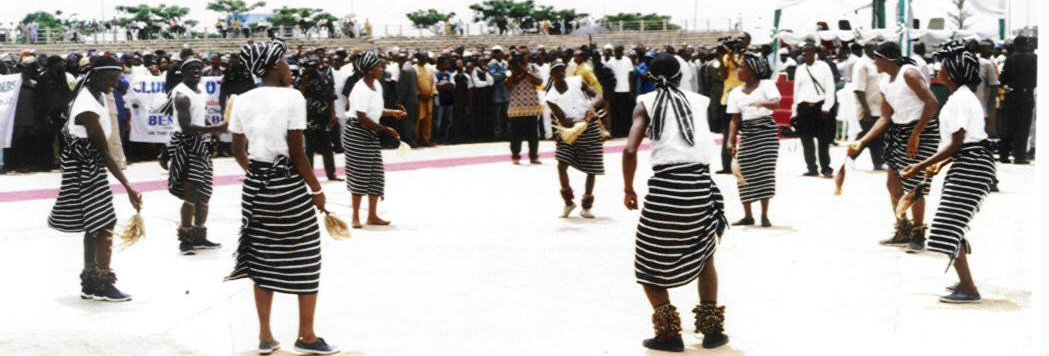
Ayatutu Ka Uno? Ka Se!
The Tiv people from the middle-belt region of Nigeria in West Africa can be found along Latitude 6 degrees 30 minutes to 8 degrees North and Longitude 8 degrees to 10 degrees East of the equator. The Tiv people are said to have originated from south-central Africa, with over 20 generations recorded from Tiv himself to the present. Although time has obscured the exact dates of the landmarks that make Tiv history, colonial historians made efforts to tally times with significant events that make the history of a nation factual. For example, evangelists have revealed that the migration of Tiv from the southern part of Central Africa began around 1800. By 1850 Tiv descendants were seen in large numbers in the south of what we now know as River Benue.
The Tiv people are in every country of the world, but mainly in Benue, Taraba, Nassarawa and Plateau State in Nigeria, West Africa. The Tiv, who are mostly agrarian farmers numbered more than 2,2m in the 1991 census. Their language is also Tiv and, even though the states mentioned above are ruled by political state governors, their paramount ruler is the Tor Tiv.
Tiv are speakers of a “Bantu related language”. Their early history is covered by three theories of origin. These are the Creation, Bantu and Family theories of origin. The outline of the Tiv Creation theory attributes the creation of the world (tar) to God (Aondo). In Tiv mythology, Aondo (God) had created the world and settled closer to it until He was hit with a pestle by a woman who was pounding food. In response, He moved into the skies (kwav Aondo), which are his present abode. Though there are different versions of the creation theory, and there does not seem to be any particular sequence in the creation process, in at least, one version, Takuruku rather than Aondo is argued to have been responsible for creation. In all the versions however, Swem is identified as the “place” of “creation”.
Language Classification:
Tiv language is classified under the the Tiv-Bantu (sub-group) of the Bantoid branch of the Benue-Congo subdivision of Niger-Congo.
Tiv Administration:
'The local community, called a ‘tar’, "is a patri-local clan community, typically a localized patri-lineage, composed of closely related patri-families. The community (tar) is typically equated with a minimal lineage (ipaven)." (Murdock 1958: 8) Each community is a neighbourhood of compounds, and each compound contains an extended family. The compounds are scattered over the countryside. In modern politics and administration, the Tiv are headed by a Tor-Tiv with lower Chiefs in a sequence of hierarchies across the entire Tivland. Tthe current Tor-Tiv is Orchiviligh (HRH) Alfred Akawe Torkula
Tiv Major Occupation:
Agriculture (subsistence farming) with yams, sorghum, and bulrush millet as major crops and sweet potatoes, taro, manioc, peanuts, maize, and earth peas, along with the garden crops of squash, beans, okra, peppers, onions, and tomatoes. Recently introduced cash crops are sesame, rice, and soy beans. Goats, sheep, and chickens are numerous.
Tiv Marriage System:
Ya Ngyor (exchange of sisters) was abolished in 1927 and replaced by Kem (substantial or cumulative bride-price); although elopement still exists it happens but rarely.
Tiv Beliefs:
Major religion is Christianity (mainly Catholic and NKST) together with widespread belief in, and practice of, the archaic traditional religions of Akombo, Azov and Tsav.